AGP Group Implements CME KRD51-2000 Transportation Bounce Test Systems
A Heavy-Duty Transportation Simulation Solution for Large Automotive Glass
Customer: AGP Group

Purchasing Entities: AGP PERÚ S.A.C. (Peru) / SOLIVER NV (Belgium)
Industry: Automotive Glass & Automotive Components
Application: Heavy-Duty Transportation Bounce Simulation Testing
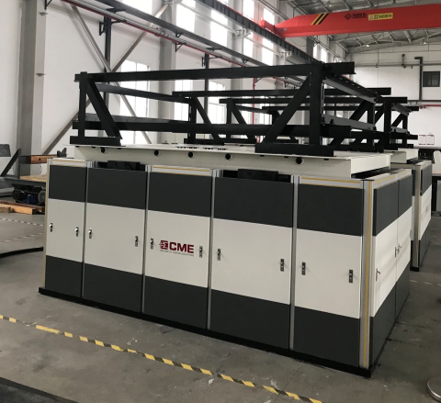
Equipment: KRD51-2000 Transportation Bounce Test System
Challenge
Automotive glass and large automotive components are exposed to continuous bouncing, impact, and friction during production, storage, and long-distance transportation.
In real transportation conditions, cargo is not always completely fixed. When a truck travels over potholes, unpaved roads, or other rough road surfaces, products may bounce vertically, move horizontally, and collide with the vehicle floor, side barriers, or other cargo.
For large automotive glass products, their size, weight, and high value make them particularly sensitive to mechanical conditions during transportation. Traditional transportation experience alone cannot fully validate product reliability after long-distance transportation.
AGP Group is an important global automotive glazing company. AGP Peru's automotive glass business includes customers such as Tesla, while SOLIVER NV represents AGP Group's automotive glass operations in Belgium.
Therefore, AGP Group required a professional solution capable of performing heavy-duty transportation simulation testing for large and high-value automotive glass products.
Key challenges included:
Large testing space requirements for automotive glass;
High product weights beyond the capability of conventional transportation testers;
Need to simulate real-world road transportation conditions;
Need to evaluate product and packaging reliability during long-distance transportation;
Compliance with international transportation and environmental test standards.
Solution
To meet AGP Group's transportation testing requirements for large automotive glass products, CME supplied KRD51-2000 Transportation Bounce Test Systems to AGP PERÚ S.A.C. in Peru and SOLIVER NV in Belgium.
The KRD51-2000 is specifically designed to simulate the random bouncing, movement, impact, and friction experienced by products transported as loose cargo in trucks and other transportation vehicles.
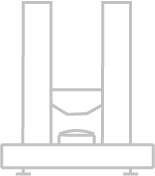
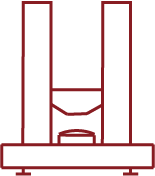
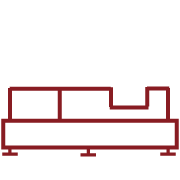
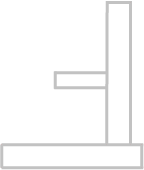
During testing, specimens can be freely placed at the center of the working table without being fixed, according to the applicable test requirements. The eccentric mechanisms drive the working table in an approximately circular motion, creating continuous random movement and impact similar to actual road transportation conditions.
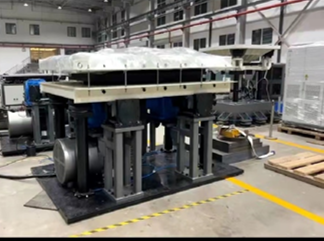
The KRD51-2000 uses a four-bearing eccentric mechanism. Through motor reduction, chain transmission, and eccentric shafts, the working table performs an approximately circular motion with a diameter of 25.4mm. The test motion is controlled by the rotational speed of the eccentric mechanism.
Solution Advantages
Heavy-Duty Transportation Simulation Capability
The KRD51-2000 provides a maximum test load of 2,000kg, making it suitable for large automotive glass products and other heavy-duty products.
The working table measures 2700mm × 1800mm, providing sufficient space for large specimens.
Realistic Transportation Simulation
The system simulates the actual movement of loose cargo during transportation.
During testing, the specimen is allowed to move freely, while the continuous table motion generates bouncing, impact, and friction, providing a realistic simulation of long-distance road transportation.
Large-Specimen Testing Capability
With a 2700mm × 1800mm working table, the KRD51-2000 provides sufficient testing space for large automotive glass products and automotive components.
Adjustable Enclosure Design
The system is equipped with adjustable enclosures to limit the horizontal movement of the specimen and withstand impacts generated during testing.
The enclosure dimensions can be adjusted according to specimen size, allowing the system to accommodate different product dimensions.
Stable Four-Bearing Eccentric Mechanism
The four-bearing eccentric mechanism provides stable table movement and accurate rotational speed control.
The seated bearing design also reduces friction between the shaft and bearing during table movement, helping to reduce shaft heating under demanding operating conditions and improving long-term equipment reliability.
Efficient Automated Control
The system uses a Siemens PLC controller and true-color touchscreen. Equipment parameters can be configured through the human-machine interface.
Test duration can be freely set, and the system automatically stops after completion of the test, improving operational convenience and automation.
Transportation Bounce Testing Capability
Key technical specifications of the KRD51-2000:
Maximum Load: 2,000kg
Working Table Size: 2700mm × 1800mm
Displacement: 25.4mm
Test Frequency: 2–5Hz
Test Motion: Approximately circular motion
Specimen COG Height: <700mm
Power Supply: 3-phase AC380V ±10%, 50/60Hz
Overall Dimensions: 3120mm × 2100mm × 1850mm
Equipment Weight: 8,500kg
2000kg-load Test
Set freq. (Hz) | Measured freq. (Hz) | Target speed (rpm) | Measured value (rpm) | Error (rpm) | Run time (min) |
2.5 | 2.48 | 150 | 150.11 | 0.11 | 120 |
3.0 | 2.99 | 180 | 180.08 | 0.08 | 120 |
3.5 | 3.51 | 210 | 210.23 | 0.23 | 120 |
4.0 | 3.98 | 240 | 240.12 | 0.12 | 120 |
4.5 | 4.51 | 270 | 270.21 | 0.21 | 120 |
5.0 | 5.04 | 300 | 300.05 | 0.05 | 240 |
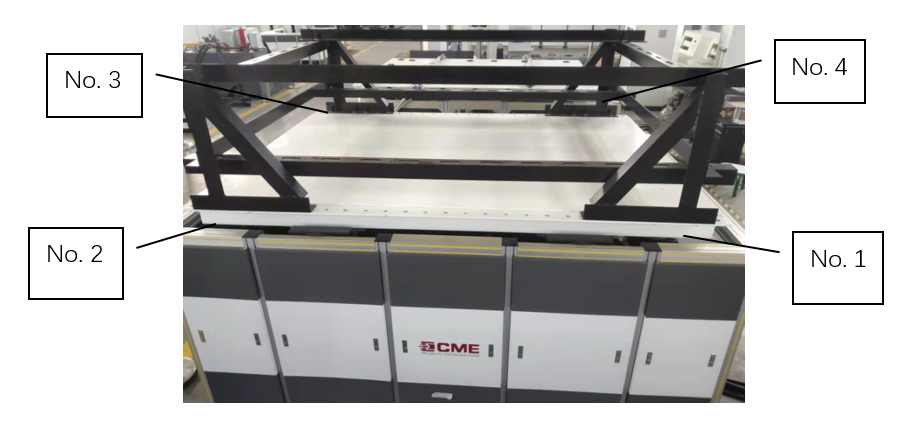
Measurement of displacement on specified position
Position No. | Disp. average (mm) | Error (mm) | Position No. | Disp. average (mm) | Error (mm) |
No. 1 | 25.00 | 0.40 | No. 3 | 24.2 | 1.2 |
No. 2 | 25.30 | 0.10 | No. 4 | 24.8 | 0.6 |
Applicable Standards
The KRD51-2000 supports transportation packaging and environmental testing according to:
ISTA 1A
ISTA 1B
ISTA 1C
ISTA 1D
ISTA 1E
ISTA 2A
ISTA 2B
ASTM D999-A2
ISO 2247
MIL-STD-810
IEC 60068-2-55
Results
By deploying KRD51-2000 Transportation Bounce Test Systems, AGP Group established heavy-duty transportation simulation testing capabilities through its operations in Peru and Belgium.
Established Heavy-Duty Transportation Simulation Capability
The 2,000kg maximum load capacity and 2700mm × 1800mm working table provide sufficient testing capability for large automotive glass products and automotive components.
Enhanced Automotive Glass Transportation Reliability Validation
By simulating bouncing, impact, and friction during actual transportation, the system enables a more comprehensive evaluation of automotive glass reliability during long-distance transportation.
Supporting Validation of High-Value Automotive Glass
For large and high-value automotive glass products, the KRD51-2000 provides a professional heavy-duty transportation simulation solution, allowing customers to reproduce realistic transportation conditions in a controlled laboratory environment.
Compliance with International Transportation Test Standards
Support for ISTA, ASTM, ISO, MIL-STD, and IEC standards provide technical support for transportation reliability validation of automotive glass and other products.
Improved Transportation Reliability
By simulating actual transportation conditions before product delivery, manufacturers can identify potential issues related to packaging, transportation restraints, and product structure, helping reduce the risk of transportation damage.