Customer
China Aerospace Science and Industry Co., Ltd.
Industry: Aerospace / High-Reliability Equipment
Application: Shock Response Spectrum Testing / Environmental Reliability Verification
Equipment: CME KRD15-100A Pneumatic Horizontal Dual-Table Shock Response Spectrum Test System
Industry Background
Aerospace equipment is often required to maintain reliable operation under complex mechanical shock environments. Transient shocks encountered during transportation, launch, separation, and other mission-related conditions may impose significant loads on structures, connections, and sensitive components.
For this reason, laboratory shock testing plays an important role in environmental reliability verification. By reproducing representative shock environments, engineers can evaluate the response characteristics, structural integrity, and reliability of equipment under shock loading.
Compared with a simple peak-acceleration test, Shock Response Spectrum (SRS) testing evaluates shock response across different natural frequencies, making it suitable for analyzing the effects of complex shock environments on different structures and components.
The CME KRD15 series is designed for this type of shock response spectrum testing. The technical proposal describes SRS testing as a method for more realistically evaluating the response of products under shock and assessing their reliability and structural integrity.
Testing Challenges
For aerospace environmental reliability testing, an SRS test system needs to combine high shock-response capability, broad frequency coverage, accurate spectrum control, and repeatable testing performance.
The key testing requirements included:
Establishing reliable horizontal shock response spectrum testing capability
Covering a broad SRS frequency range
Providing effective control of SRS amplitude and slope
Accommodating test articles of different sizes
Integrating shock signal acquisition, frequency-domain analysis, and SRS analysis
Providing a stable laboratory platform for high-reliability equipment shock-environment verification
CME Solution
To address the requirements of aerospace shock-environment testing, CME provided the KRD15-100A Pneumatic Horizontal Dual-Table Shock Response Spectrum Test System.
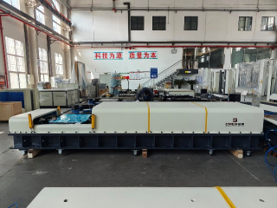
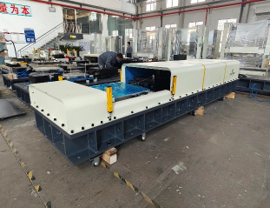
The system adopts a pneumatic horizontal operating mode and uses an expansion shock cylinder as the power source. The stored pneumatic energy drives the horizontal impact hammer to strike the response plate and generate a shock waveform corresponding to the required shock response spectrum.
Different SRS test conditions can be achieved by adjusting the shock-cylinder pressure, impact distance, and the physical characteristics of the waveform generators installed at the front and rear of the response plate.
The KRD15-100A is equipped with two response plates—600 × 600 mm and 800 × 800 mm—and supports a maximum payload of 100 kg, providing flexibility for different test article sizes and test conditions.
Key Advantages of the CME KRD15-100A
01|Dual-Table Configuration
The system includes two response plates:
The dual-table configuration allows the appropriate response plate to be selected according to the size of the test article and test requirements.
02|Wide-Frequency SRS Testing
The system provides a maximum response frequency of 10 kHz, with an SRS calculation frequency range of 5 Hz–10 kHz, supporting a broad range of shock response spectrum testing applications.
03|Accurate SRS Control
The specified SRS control tolerance is ±6–9 dB, with an SRS rising slope of 6–9 dB/Oct and a corner-frequency range of 200–2000 Hz.
04|Pneumatic Drive and Stable Control
The system uses pneumatic drive technology, with shock energy controlled through air-pressure adjustment. Its circulating air-storage and automatic chamber-switching design helps reduce air consumption and improve operating efficiency.
The response-plate support system also incorporates pneumatic buffering adjustment for SRS slope control, while the pneumatic locking mechanism provides stable locking during operation.
05|Integrated SRS Measurement and Analysis
The KRD15-100A is equipped with a dedicated shock response spectrum control and measurement system supporting multi-channel data acquisition, frequency analysis, and SRS analysis.
The system also supports test-data storage, waveform analysis, SRS tolerance settings, and test-report generation.
Technical Configuration
Item | KRD15-100A |
Operating Mode | Pneumatic Horizontal |
Maximum Payload | 100 kg |
Small Table Size | 600 × 600 mm |
Large Table Size | 800 × 800 mm |
Maximum Shock Response Acceleration — Small Table | 120,000 m/s² |
Maximum Shock Response Acceleration — Large Table | 100,000 m/s² |
Tolerance Range | ±6–9 dB |
Gradient of Rising Stage | 6–9 dB/Oct |
Knee Frequency | 200–2000 Hz |
Maximum Response Frequency | 10 kHz |
SRS Calculation Frequency Range | 5 Hz–10 kHz |
Control | Computer-Based Control & Measurement |
Project Summary
To address the demanding environmental testing requirements of aerospace equipment, CME provided the KRD15-100A Pneumatic Horizontal Dual-Table Shock Response Spectrum Test System.
With its dual response plates, pneumatic shock generation, wide-frequency SRS capability, precise spectrum control, and integrated data acquisition and analysis, the KRD15-100A provides a comprehensive platform for shock-environment verification of high-reliability equipment.